
Almost nobody reads patent filings. We understand why. They are long, written in a dialect engineered to obscure rather than inform, and whatever is interesting tends to sit behind forty pages of excipient ratios and dissolution curves. Fortunately, a few investors we know do read them. They dug through the recent filings of a tiny rare disease company, found some interesting, not-yet-widely-known data, and were kind enough to share them with us.
Last November, Pasithea Therapeutics (Nasdaq: KTTA) filed a patent on a tablet formulation of its lead drug, PAS-004, a next-generation macrocyclic MEK inhibitor. It published on May 28th. Buried in the back of it is the first real visibility anyone has had into what PAS-004 is doing in neurofibromatosis type 1 (NF1). (WO 2026/112507, for anyone who wants to read along.)
PAS-004 for NF1 is the kind of orphan setup we like. The genetics of NF1 are unambiguous, the MEK mechanism is already validated, and two drugs have made the commercial case emphatically. AstraZeneca’s Koselugo (selumetinib) and Merck KGaA’s Gomekli (mirdametinib), both MEK inhibitors, combined for over $700 million in NF1 sales in 2025, up from $37 million five years earlier.
But those incumbent molecules carry real vulnerabilities. Both are dosed twice daily, both are hard on the skin and the gut, and a meaningful share of adults stop taking them. They also treat only plexiform neurofibromas (PN), the manifestation affecting a third to a half of patients, while cutaneous neurofibromas (CN), which affect nearly all adult patients, have no approved systemic therapy. The mechanism works; there is plenty of room for improvement.
Pasithea believes PAS-004 can overcome the shortcomings of incumbent MEK inhibitors. Interim data from its Phase 1 oncology trial indicate that PAS-004 supports once-daily dosing and has a markedly improved safety and tolerability profile compared with first-generation MEK inhibitors. Some may question whether a dramatically improved safety profile, on a target notorious for poor tolerability, is simply a function of underdosing. The answer should come next month in Vienna, where Pasithea presents its first NF1 data at the European Neurofibromatosis Conference. However, as we hinted above, some investors have already found the answer buried in a patent. It’s low-dose, early, interim data, but PAS-004 certainly looks active in NF1.
With the stock around $0.40, the market is valuing Pasithea below its $45.6 million cash balance (06/30). Pasithea is trading as if investors don’t expect PAS-004 to work in NF1, or perhaps they think next month’s data from Vienna will be too early for the drug to show an effect. But here’s the twist: early human evidence that PAS-004 is active in NF1 is already available.
Broken Switch
But first, let’s get everyone up to speed on the disease. Inside every cell sits a protein called RAS, which relays the instruction to grow and divide down a chain of enzymes toward the nucleus. RAS is built as a switch, and the protein that switches it off is neurofibromin, which the NF1 gene encodes. Patients with NF1 inherit a copy of that gene that cannot do the job. The switch stays on, the downstream chain runs unchecked, and benign tumors form along nerves throughout the body, from major nerve trunks deep in tissue to the surface of the skin. Neurofibromin itself cannot be replaced, so the practical answer has been to block something further down the chain: an enzyme called MEK.
Most investors know MEK inhibitors from oncology, where trametinib, cobimetinib, and binimetinib entered the market between 2013 and 2018, primarily for melanoma and typically paired with a BRAF inhibitor. The dosing convention also came from that setting. In advanced melanoma, you give as much drug as the patient can tolerate, because the cost of giving too little is measured in months of life.
NF1 is not cancer, though it is not entirely benign either. Cutaneous lesions never become malignant; plexiform neurofibromas sometimes do, and roughly 8% to 13% of people with NF1 develop a malignant peripheral nerve sheath tumor (MPNST) at some point in life. This underscores the need to control plexiform disease early and continuously, which in turn requires a drug patients can take continuously. Most NF1 patients live a normal lifespan with the condition, so management lasts decades, which changes what “tolerable” means.
Crying Uncle
This brings us to the two approved drugs for NF1. Selumetinib and mirdametinib both began as oncology compounds, had setbacks in mid-stage studies, and were repurposed for NF1. They work, as the $700 million in combined annual sales indicates. They are also hard to take, precisely because they were designed around oncology dosing thresholds. To keep patients on therapy, clinicians have relied on frequent dose interruptions, reductions, and intermittent three-weeks-on, one-week-off cycles.
The evidence is directly in their labels. Across both drugs, rash occurs in 85% to 92% of adults versus 23% on placebo, while diarrhea occurs in 42% to 59% versus 12%. Both require twice-daily dosing. On selumetinib, 13% of adults discontinued permanently because of adverse reactions, and a further quarter had dosing interrupted; on mirdametinib, 22% discontinued outright, with gastrointestinal toxicity the leading cause and rash the second. Yet their clinical efficacy is real: adult response rates in their respective pivotal trials range from 20% for selumetinib in KOMET to 41% for mirdametinib in ReNeu.
That leaves two drugs generating nearly three-quarters of a billion dollars in a market where a substantial share of adults eventually cry uncle. The unmet need in NF1 is no longer simply finding a drug that shrinks a tumor. It is finding a drug patients can actually stay on.
60 Hours
PAS-004 was designed differently from the first-generation MEK inhibitors. It is macrocyclic, a molecule engineered into a rigid, closed ring that liver enzymes struggle to break down. Instead of clearing within hours, it lasts days, with a half-life of about 60 hours.
That single design choice changes everything for the patient. Because the drug lingers, it doesn’t need to be dosed twice a day, and it doesn’t need to spike into the bloodstream to do its job. It delivers steady, continuous pressure on the tumor with a single daily pill.
The early clinical experience reflects that difference. Among 34 advanced cancer patients treated in its ongoing dose-escalation trial, rash occurred in 12% and diarrhea in 6%. All treatment-related events were mild or moderate, and none led to discontinuation. Among those treated longest, including four patients past 300 days and two past a year, there was no rash or diarrhea.
The Oncology Detour
A fair question is why a company whose stated destination was always NF1 spent two years testing on late-stage oncology patients.
PAS-004 was never designed as an oncology drug, but Pasithea chose plexiform disease as its lead indication, and that choice set the Phase 1 path. PN is reviewed by the FDA’s oncology division (more on this later), where first-in-human means dose escalation in advanced cancer patients. Running a Phase 1 in advanced cancer carried some clear advantages. A healthy-volunteer study would have answered the pharmacokinetic questions in a few weeks and stopped there. These patients have been dosed continuously for months, which tells you far more about a drug’s longer-term tolerability. The setting also let Pasithea push escalation cohorts toward a true ceiling, confirm the drug was shutting down its target in humans, and look for early signs of tumor response. The ongoing Phase 1 oncology study has done exactly that: it confirmed a half-life near 60 hours, showed up to 91% pathway inhibition, and produced zero dose-limiting toxicities across eight escalation cohorts, alongside early signals of disease control in BRAF-mutated patients.
It also served as the proving ground for the tablet. The cancer study began with a capsule, but Pasithea developed a proprietary tablet formulation, securing an additional layer of patent protection while testing the two side by side. The tablet proved roughly three times more bioavailable on a milligram-for-milligram basis, with an 8 mg tablet modestly outperforming a 22 mg capsule. That finding allowed the NF1 trial to open directly on lower-dose tablets, while the cancer study continues to escalate through 40- and 52-mg tablets to define the upper ceiling.
That brings us to the NF1 study itself. In mid-2025, Pasithea launched a multicenter Phase 1b trial designed to assess clinical activity in adults with symptomatic, inoperable PNs. Dosing began with 4 mg and 8 mg cohorts, and a June 2026 amendment expanded escalation through intermediate tiers to 24 mg and 32 mg and extended treatment to 18 months. Importantly, the study will evaluate both disease manifestations: investigators will track internal PN tumor volume via centralized volumetric MRI scans and take direct digital caliper measurements of the CNs for the same patients.
The two studies divide the labor: the cancer trial defines the safety ceiling, while the Phase 1b trial looks for the efficacy signal that truly matters to patients and investors.
Example 16
Finally, we arrive at the aforementioned patent, published this May. Ostensibly filed to protect the proprietary tablet formulation and its manufacturing process, the patent’s back pages contained something far more consequential: the first clinical efficacy data for PAS-004 in humans with NF1.
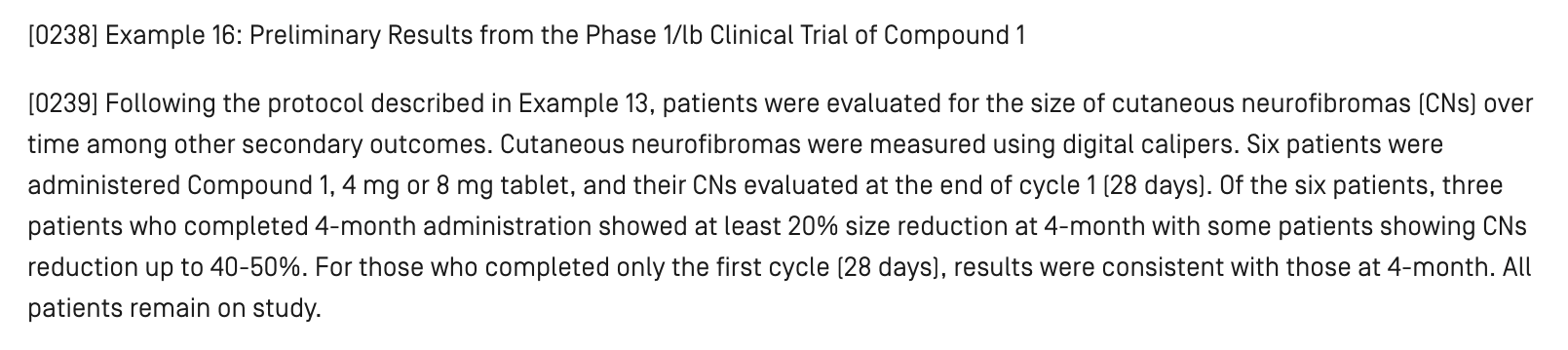
Example 16 included a preliminary summary of six adult NF1 patients dosed with 4 mg or 8 mg tablets—the trial’s initial, lowest-dose cohorts. Because patients enrolled sequentially, the three patients in the 4 mg cohort had completed four months of continuous daily treatment by the filing cutoff, while subsequent patients in the 8 mg tier had reached one-month evaluations. The patent states that all three patients evaluable at four months had at least a 20% reduction in CN, as measured with digital calipers, with some showing 40% to 50% CN reduction. It further states that for the 8 mg cohort, which was evaluable only at one month, CN reductions were similar to those seen in the 4 mg group at four months.
As we said before, these are early interim data. Nevertheless, in a manifestation of NF1 for which no systemic drug is approved, and at dose levels intended primarily to establish a baseline safety floor, some human tumors were already shrinking by nearly half. Because patent filings are painfully hard to read, the data quietly entered the public record months ahead of any medical conference, without the broader market noticing.
Skin First
It is important to note why Pasithea shared early CN efficacy from Phase 1b but not any PN data. CN and PN tumors respond to MEK inhibition at different rates. PNs are dense, internal, slow-growing masses, and meaningful volume reductions on an MRI typically take eight to twelve months to appear. CNs are superficial and tend to respond much faster once the MEK signaling pathway is turned off. That’s why CNs respond to PAS-004 in as little as four weeks, whereas the PN data has not yet been shared.
That will change next month, when Pasithea has two presentations at the European Neurofibromatosis Conference in Vienna—a poster on the plexiform data and an oral slot for the cutaneous cohort—billed as the first public disclosure of the trial. The company noted in a June release that the dose-escalation phase had already enrolled and dosed 18 patients. As a result, Vienna is likely to provide data from additional dose cohorts and longer treatment durations than the patent disclosed, along with the first look at volumetric MRI results in plexiform disease. For the few who read the patent in May, the trial has already yielded the first breadcrumbs of evidence, with more to come next month.
Two Tracks
Pasithea’s regulatory path will likely be broader than that of its MEK-inhibitor peers, which focused almost exclusively on PN. As the company notes in its presentation, PN and CN represent “two distinct opportunities within one rare disease.” That distinction is not merely commercial positioning; it reflects a genuine regulatory divide. The FDA evaluates the two manifestations through different divisions with divergent clinical standards, forcing any program pursuing both to follow two separate clinical tracks.
The PN clinical path is well established within the FDA’s oncology division, first with AstraZeneca and more recently with SpringWorks before Merck KGaA acquired it. Pasithea is following that precedent directly. Although the ongoing Phase 1b is limited to adults, the company plans to initiate a pediatric Phase 1 to support registrational trials in both adult and pediatric populations, mirroring the dual-cohort architecture of SpringWorks’ ReNeu study.
The aim is a PN label that matches the incumbents, both of which now cover adults and children. Plexiform tumors also grow fastest in childhood, when treatment is most effective, and the Rare Pediatric Disease Designation already granted for PAS-004 puts an FDA Priority Review Voucher in play upon approval.
PN’s advantage is an unambiguous regulatory bar; its liability is time. SpringWorks needed only 58 adults and 56 children for ReNeu, but two years of recruitment, followed by a 24-month evaluation protocol, stretched the timeline to four years from trial start to final readout. The patient numbers are modest; the timeline is not.
CN enters a very different regulatory environment under the FDA’s dermatology division, with no precedent for approval. While tumor reduction (ORR) remains a shared requirement across both manifestations, simply shrinking surface lesions will not be sufficient for approval. Because patients live with these tumors indefinitely without life-threatening complications, the agency will likely insist on demonstrating symptomatic and psychosocial benefit—mandating patient-reported outcomes (PROs) for pain, pruritus, or disfigurement alongside tumor response. Subjective endpoints require a randomized, double-blind, placebo-controlled trial, and the sample size will be determined by powering for those PROs.
Almost all adult NF1 patients have cutaneous lesions, so recruitment should be much faster than for PN, and CNs respond to MEK inhibition more quickly than plexiform tumors. In PAS-004’s Phase 1b, visible regression appeared at one month, making a four- to six-month primary endpoint plausible for a CN pivotal trial. A CN trial would require more patients, but it could yield an answer sooner.
Three Dates
The next five weeks should be eventful for Pasithea.
First comes ESMO in Madrid this Friday, October 23, where additional dose-escalation data will show whether PAS-004’s clean safety profile holds as doses are escalated to 40 mg and 52 mg in the Phase 1 oncology study.
Attention then shifts to Vienna. On November 12, a poster presentation will deliver the first volumetric MRI readouts in PN—again, a slower-responding tumor type, so set expectations accordingly.
The following morning, the CN data takes the podium for an oral presentation. For anyone who tracked the patent filings, the core biological signal was evident months ago, but Vienna should build on those early findings with more patients, longer follow-up, and results from dose levels the patent never covered.
Curtain Up In Vienna
As we stated in our opening, PAS-004 for NF1 is the kind of orphan setup we like.
The mechanism is validated. Commercial demand is proven. The incumbent drugs have clear tolerability ceilings, and cutaneous disease remains completely unaddressed. Against that backdrop, PAS-004 already showed tumor shrinkage at the bottom of its dose curve—tucked away in a patent filing that went unnoticed.
Vienna puts the data on the podium. Higher cohorts, longer treatment duration, and the first plexiform scans enter the public record next month. If the data continue to look good and the equity doesn’t react, maybe reading patents really isn’t important.